


In 2026, social media is no longer just part of young Australians’ lives, it is the environment they grow up in, think through, and define themselves within. It shapes how they communicate, form identity, maintain friendships, while also serving as a key space for information, communities, trends, and news. Social media has become a major youth policy issue, influencing wellbeing, relationships and opportunity. As artificial intelligence (AI) becomes increasingly embedded in online platforms, these spaces are more complex and harder to regulate. While the Australian Government has introduced an under-16 social media ban, lasting solutions must go further, centred on youth voice, education and platform responsibility. Social media, AI and mental health are expected to be central themes in the Australian Youth Representative Program’s 2026 Report, which will amplify young Australian voices. Social media is a primary space for communication, connection and self-expression for young Australians. One 15-year-old male from Christmas Island stated “we use social media to connect with family and friends on the mainland – it’s how we stay human.” According to Mission Australia’s 2024 Youth Survey of 17,480 young people, “97% of young people [use] social media daily, and nearly 40% [spend] three or more hours online each day” (Orygen and Mission Australia 2025). This level of use demonstrates how deeply embedded social media is in youth life. Platforms are designed to maximise engagement, encouraging constant scrolling, comparison and continuous connection, shaping behaviours and expectations with real consequences for youth wellbeing. For young Australians, the digital world is deeply embedded in everyday life, making its mental health impacts increasingly urgent. Social media presents significant challenges. Comparison culture can damage confidence and self-esteem, while constant connectivity creates pressure to always be available and responsive. Cyberbullying and exclusion now extend beyond school hours, blurring the boundaries between school, home and social life. Algorithm-driven feeds can reinforce harmful or negative content, contributing to cycles of distress, and excessive use is often linked to disrupted sleep, reduced concentration and difficulties with emotional regulation. Australian Youth Representative Janice Rodrigues has highlighted concerns around “body dysmorphia, stress and mental health” linked to social media. These challenges are compounded by gaps in youth mental health support. One 18-year-old female from Western Australia stated, “the system is working exactly how it was designed—to exclude,” reflecting widespread concerns about access. For many young Australians, mental health support can “feel like a lottery” (UN Youth Australia 2025). These challenges are intensifying as social media becomes increasingly AI-powered. AI now shapes what users see, how long they stay online, and what content is prioritised. AI-generated images, videos and deepfakes are also reshaping trust, information integrity and mental health. Janice Rodrigues has noted concerns that young people are often “not being able to tell what is AI and what is real,” contributing to misinformation and confusion online. ACMA research shows that 46 per cent of 18–24-year-olds identify social media as their main source of news, with many relying on influencers for information (ACMA 2025). With AI’s power and influence only continuing to grow, youth are now no longer just navigating social media, but also AI-driven environments designed to capture attention and shape behaviour. Policy must treat social media and AI as interconnected. The Australian Government’s Social Media Minimum Age Act, which came into effect in December 2025, prohibits Australians under 16 from holding social media accounts, with fines up to $50 million for non-compliant platforms (UNICEF Australia 2026). However, a Reuters article highlights that according to tech providers, the ban is ‘marred by weak platform checks’ (Reuters 22 April 2026). While some young people may bypass restrictions, the issue extends beyond access. Delaying social media use does not address structural harms such as addictive design, algorithmic amplification of harmful content, and limited moderation. Young Australians are not alone in this struggle, as the harms associated with social media extend to young Australians aged 16 to 25 and beyond. While the ban is a positive step, restriction alone is insufficient. Without stronger investment in education and digital literacy, it does little to build long-term resilience and safety needed to navigate complex online environments. Young Australians are often excluded from decisions that directly affect them, despite having clear insight into their lived experiences. One 17-year-old female from Victoria stated, “a social media ban doesn’t tackle the harm, it just takes away the only place young people can still reach each other.” Effective policy must be grounded in lived experience. Young people should be meaningfully involved in shaping policy responses to the interconnected challenges of social media, AI and mental health. Long-term solutions must go beyond restriction, focusing instead on transforming digital environments to better protect, support and empower young Australians. Reference List ACMA (2024) ACMA research reveals Australian news consumption trends, ACMA, accessed 6 May 2026, https://www.acma.gov.au/articles/2024-02/acma-research-reveals-australian-news-consumption-trends Orygen and Mission Australia (2025) Social Media & Young People in Australia: Findings from the 2024 Mission Australia Youth Survey, accessed 6 May 2026, https://yfsejk.files.cmp.optimizely.com/download/assets/report-mission-australia-social-media-and-young-people.pdf/75a95084b45611f0be35caef1e1740e8 Reuters (22 April 2026) ‘Australian social media ban marred by weak platform checks, tech providers say’, Reuters, accessed 6 May 2026, https://www.reuters.com/legal/litigation/australian-social-media-ban-marred-by-weak-platform-checks-tech-providers-say-2026-04-22/ UNICEF Australia (2026) Social media ban, UNICEF Australia, accessed 6 May 2026, https://www.unicef.org.au/unicef-youth/staying-safe-online/social-media-ban-explainer UN Youth Australia (2025) Explore the Youth Representative Report, UN Youth Australia, accessed 6 May 2026, https://unyouth.org.au/explore-the-youth-representative-report/ 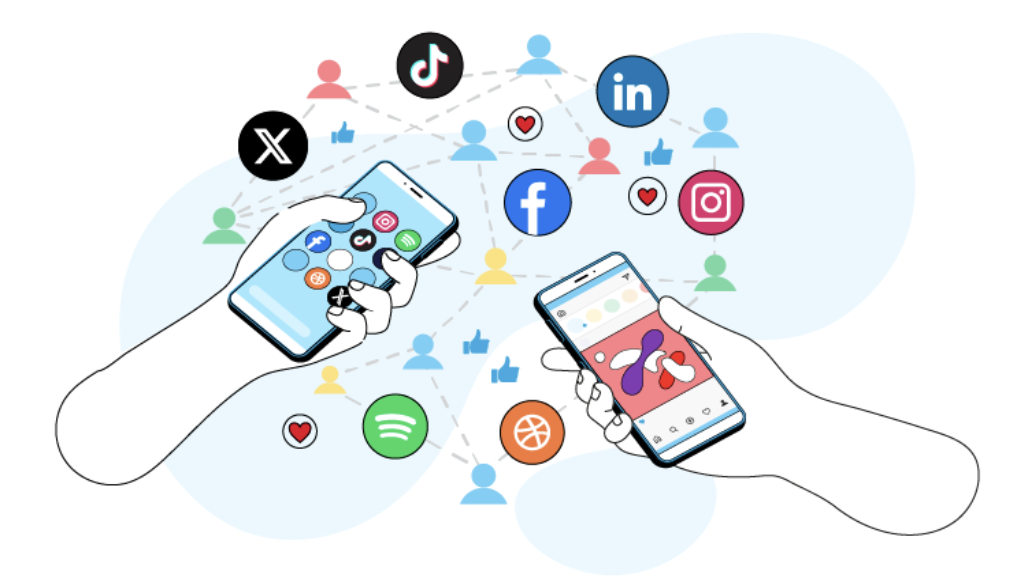 Image: Tridens Technology
Social Media as a Daily Reality
The Mental Health Impact
How AI is Changing Social Media
The Under-16 Ban
 Image: Shutterstock
 Young Australians must be Part of the Solution
In 2026, social media is no longer just part of young Australians’ lives, it is the environment they grow up in, think through, and define themselves within.
It shapes how they communicate, form identity, maintain friendships, while also serving as a key space for information, communities, trends, and news.
 Image: Tridens Technology
Social media has become a major youth policy issue, influencing wellbeing, relationships and opportunity. As artificial intelligence (AI) becomes increasingly embedded in online platforms, these spaces are more complex and harder to regulate.
While the Australian Government has introduced an under-16 social media ban, lasting solutions must go further, centred on youth voice, education and platform responsibility.
Social media, AI and mental health are expected to be central themes in the Australian Youth Representative Program’s 2026 Report, which will amplify young Australian voices.
Social Media as a Daily Reality
Social media is a primary space for communication, connection and self-expression for young Australians. One 15-year-old male from Christmas Island stated “we use social media to connect with family and friends on the mainland – it’s how we stay human.”
According to Mission Australia’s 2024 Youth Survey of 17,480 young people, “97% of young people [use] social media daily, and nearly 40% [spend] three or more hours online each day” (Orygen and Mission Australia 2025). This level of use demonstrates how deeply embedded social media is in youth life.
Platforms are designed to maximise engagement, encouraging constant scrolling, comparison and continuous connection, shaping behaviours and expectations with real consequences for youth wellbeing.
The Mental Health Impact
For young Australians, the digital world is deeply embedded in everyday life, making its mental health impacts increasingly urgent.
Social media presents significant challenges. Comparison culture can damage confidence and self-esteem, while constant connectivity creates pressure to always be available and responsive. Cyberbullying and exclusion now extend beyond school hours, blurring the boundaries between school, home and social life. Algorithm-driven feeds can reinforce harmful or negative content, contributing to cycles of distress, and excessive use is often linked to disrupted sleep, reduced concentration and difficulties with emotional regulation.
Australian Youth Representative Janice Rodrigues has highlighted concerns around “body dysmorphia, stress and mental health” linked to social media.
These challenges are compounded by gaps in youth mental health support. One 18-year-old female from Western Australia stated, “the system is working exactly how it was designed—to exclude,” reflecting widespread concerns about access. For many young Australians, mental health support can “feel like a lottery” (UN Youth Australia 2025).
How AI is Changing Social Media
These challenges are intensifying as social media becomes increasingly AI-powered. AI now shapes what users see, how long they stay online, and what content is prioritised. AI-generated images, videos and deepfakes are also reshaping trust, information integrity and mental health.
Janice Rodrigues has noted concerns that young people are often “not being able to tell what is AI and what is real,” contributing to misinformation and confusion online.
ACMA research shows that 46 per cent of 18–24-year-olds identify social media as their main source of news, with many relying on influencers for information (ACMA 2025).
With AI’s power and influence only continuing to grow, youth are now no longer just navigating social media, but also AI-driven environments designed to capture attention and shape behaviour. Policy must treat social media and AI as interconnected.
The Under-16 Ban
The Australian Government’s Social Media Minimum Age Act, which came into effect in December 2025, prohibits Australians under 16 from holding social media accounts, with fines up to $50 million for non-compliant platforms (UNICEF Australia 2026). However, a Reuters article highlights that according to tech providers, the ban is ‘marred by weak platform checks’ (Reuters 22 April 2026).
 Image: Shutterstock
While some young people may bypass restrictions, the issue extends beyond access. Delaying social media use does not address structural harms such as addictive design, algorithmic amplification of harmful content, and limited moderation.
Young Australians are not alone in this struggle, as the harms associated with social media extend to young Australians aged 16 to 25 and beyond.
While the ban is a positive step, restriction alone is insufficient. Without stronger investment in education and digital literacy, it does little to build long-term resilience and safety needed to navigate complex online environments.
Young Australians must be Part of the Solution
Young Australians are often excluded from decisions that directly affect them, despite having clear insight into their lived experiences.
One 17-year-old female from Victoria stated, “a social media ban doesn’t tackle the harm, it just takes away the only place young people can still reach each other.”
Effective policy must be grounded in lived experience. Young people should be meaningfully involved in shaping policy responses to the interconnected challenges of social media, AI and mental health. Long-term solutions must go beyond restriction, focusing instead on transforming digital environments to better protect, support and empower young Australians.
Reference List
ACMA (2024) ACMA research reveals Australian news consumption trends, ACMA, accessed 6 May 2026, https://www.acma.gov.au/articles/2024-02/acma-research-reveals-australian-news-consumption-trends
Orygen and Mission Australia (2025) Social Media & Young People in Australia: Findings from the 2024 Mission Australia Youth Survey, accessed 6 May 2026, https://yfsejk.files.cmp.optimizely.com/download/assets/report-mission-australia-social-media-and-young-people.pdf/75a95084b45611f0be35caef1e1740e8
Reuters (22 April 2026) ‘Australian social media ban marred by weak platform checks, tech providers say’, Reuters, accessed 6 May 2026, https://www.reuters.com/legal/litigation/australian-social-media-ban-marred-by-weak-platform-checks-tech-providers-say-2026-04-22/
UNICEF Australia (2026) Social media ban, UNICEF Australia, accessed 6 May 2026, https://www.unicef.org.au/unicef-youth/staying-safe-online/social-media-ban-explainer
UN Youth Australia (2025) Explore the Youth Representative Report, UN Youth Australia, accessed 6 May 2026, https://unyouth.org.au/explore-the-youth-representative-report/
More Articles from the Youth Rep


About REP NET
Rep Net is the official blog run by the Australian Youth Representative to the United Nations, with UN Youth Australia.
This is a space where young people in Australia can connect with the Youth Rep, hear the latest news on the Program, and share their opinions and solutions on local and global issues affecting young people across Australia’s diverse communities and landscapes.
Young people 12 to 25 are welcome to contribute to our blog at any time!
Engage in the Listening Tour
As Australia’s largest face-to-face consultation of young people aged 12 to 25, the Listening Tour brings together young people to share their visions, challenges, and perspectives on current domestic and international issues and opportunities.